2026 Seller Guide
China to Amazon FBA: Complete Shipping Process (2026)
Amazon ended its US prep and labeling services in January 2026. Your cargo now has to leave the factory in China already 100% compliant. Here is the exact process we run for our clients — factory checks, inspection, prep, and five shipping modes with real transit times.
Read this first
What changed in 2026
Three policy changes reshaped FBA inbound this year. The practical conclusion: prep has moved upstream to China.
Jan 1, 2026
Amazon ended all US prep & labeling
No more FNSKU application, polybagging, bubble wrap or bundling at the FC — on any inbound channel. Non-compliant units are rejected or charged $0.50–$2+ per unit.
Mar 31, 2026
Commingling ended
FNSKU labeling is now effectively universal for resellers. Every sellable unit needs its own scannable FNSKU.
2026
Pallet labels: PDF417 format
Amazon US pallet labels moved to the PDF417 barcode format. Old-format labels can fail scanning at the dock.
Sellers who moved labeling and packaging to origin — where labor is cheaper and goods can be inspected in the same step — are saving 10–15% on landed cost with rejection rates under 2%. Sellers who ship "factory direct" and hope for the best are funding Amazon's chargeback program.
The process
9 steps from factory to fulfillment center
- 1
Verify your supplier (on-site factory check) 实地考察
Before large money changes hands, confirm the supplier is a real factory — not a trading company reselling. An on-site visit checks that the registered address matches reality, photographs the business license and certificates, and walks the warehouse and production equipment so you can see with your own eyes who you are paying.
What we do: WXG visits factories anywhere in China and sends you a photo report — address, business license, certificates, warehouse and machinery — typically within 2–3 business days of booking. - 2
Pre-shipment quality inspection at the factory 驻厂质检
The fastest ship in the world cannot fix defective goods. Inspect before cargo leaves the factory — once it is on the water, your leverage with the supplier is gone. Standard scope: AQL sampling, function and safety tests, packaging and barcode verification, carton weight and dimension checks.
What we do: Our inspectors sign off carton weights and dimensions before pickup, so your FBA box labels match the physical freight — mismatches are a top Amazon rejection trigger. - 3
FBA prep & labeling at origin — mandatory in 2026 中国仓贴标打包
FNSKU on every unit (scannable, flat surface, 1/8-inch quiet zone), polybags with suffocation warnings for openings over 3 inches, sets securely taped with "Sold as set" labels, fragile items bubble-wrapped to survive a 3-foot drop. Origin-side prep is also cheaper — it happens in the same handling step as inspection and consolidation.
- 4
Create the shipment in Seller Central 创建货件
Use the Send to Amazon workflow before goods leave the warehouse: enter SKUs and packing configuration, upload box content information, let Amazon assign destination FCs, then print FBA Box ID labels and (for freight) FBA Pallet ID labels.
What we do: First shipment? We walk first-time sellers through the whole workflow — weekly routine for us. - 5
Factory pickup & consolidation 上门提货
We collect at the factory door, re-check piece count and dimensions against the shipping plan, and consolidate multiple suppliers into one shipment. Consolidation is one of the quietest cost savers in FBA logistics: one customs entry, one main leg, one delivery.
- 6
Export customs clearance in China 出口报关
Commercial invoice, packing list, export licenses where applicable. Delays here are almost always mismatched invoice data — one more reason inspection, pickup and export should be run by the same team.
- 7
Main-leg transport: sea, air or express 干线运输
Your biggest cost and time decision. See the mode comparison below — including vessel speed options most sellers never get told about.
- 8
US customs clearance & duties (DDP vs DDU) 美国清关
DDP: we clear customs and pay duties — one all-in price, no paperwork on your side; the default for most FBA sellers. DDU: you act as importer of record and pay duties on arrival. Warning from an operator: if a DDP rate looks dramatically below market, someone is under-declaring your cargo value — and when that unravels, it is the seller’s inventory that gets seized.
- 9
Final-mile delivery & FC appointment 末端派送
Express parcels (UPS/FedEx) check in fast with no dock appointment — ideal for smaller replenishments. Truck (LTL/FTL) requires a booked dock appointment, GMA-grade pallets and pallet labels; missing an appointment adds 5–10 days instantly. After delivery, receiving typically takes 1–3 business days before units go sellable.
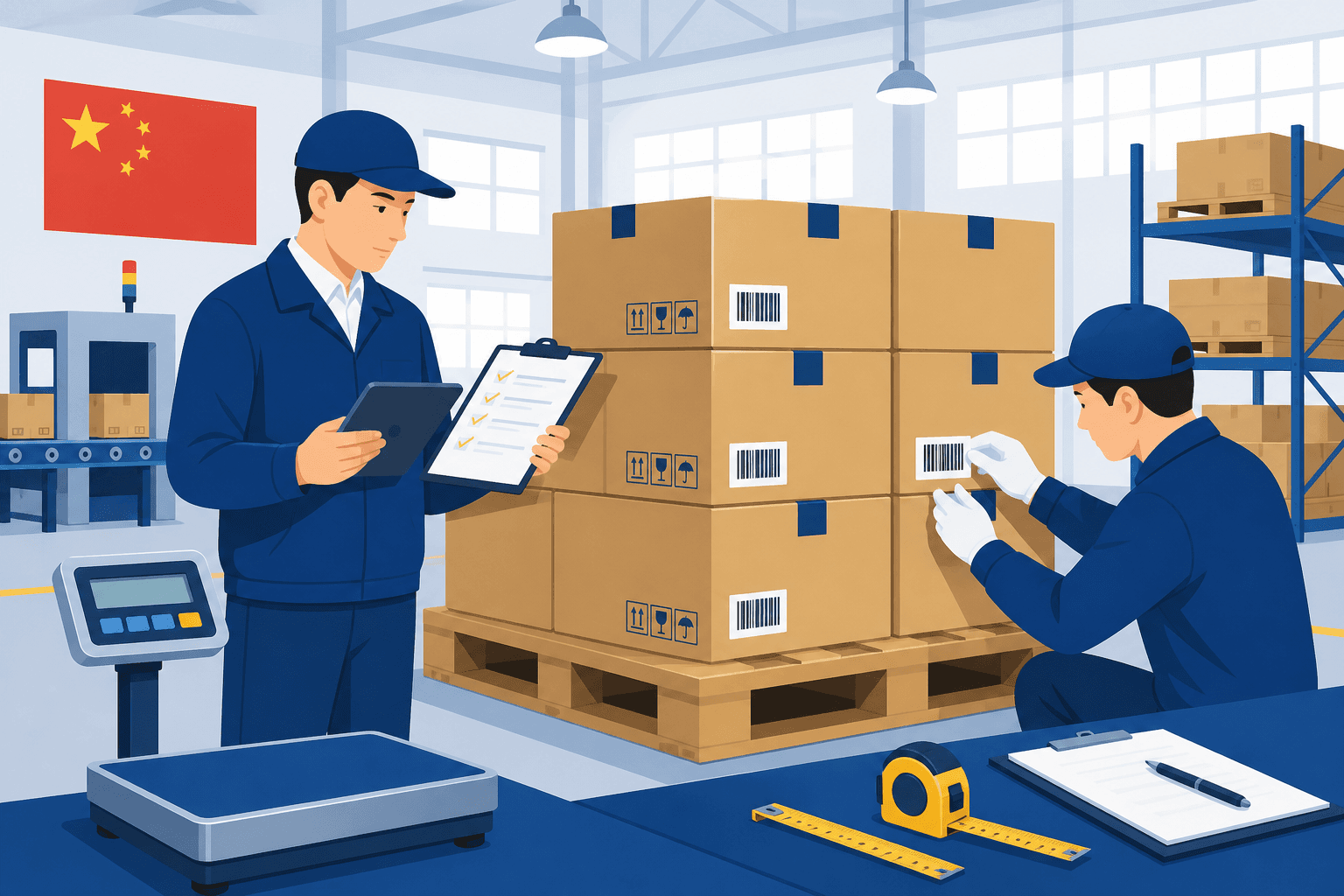
In-factory inspection and labeling — compliance problems get fixed here, not discovered at an Amazon dock in Texas.
The big decision
Choosing the right shipping mode
Sea freight is split by vessel speed — a choice many sellers never get told about. Then pick your last mile.
1 · Pick your vessel speed (sea, door-to-FC US)
Fast vessel 快船
22–25 days
Time-sensitive restocks that don’t justify air freight
Regular vessel 普通船
25–30 days
The everyday workhorse — best balance of cost and speed
Slow / economy 慢船
30–35 days
Non-urgent bulk cargo at the lowest sea cost
2 · Pick your last mile
Sea + Express 海运+快递派
Ocean to a US port, then UPS/FedEx parcels to the FC. No dock appointment, fast check-in. Ideal for small-to-mid shipments and multi-FC splits.
Sea + Truck 海运+卡派
Ocean, then palletized LTL/FTL delivery with an FC appointment. For large-volume shipments truck is significantly cheaper than express per unit — our recommendation almost every time at scale.
Need it faster?
Air + Express 空运+快递派
~8–12 days
Urgent restocks, lighter cargo
Air + Truck 空运+卡派
~10–15 days
Urgent but larger volume — truck last-mile keeps cost down
Express Direct 快递直发
~5–8 days
New-product test batches, stockout emergencies (DHL/UPS/FedEx)
Our decision shortcut
- Under ~100 kg, or testing a new product→ Express direct
- Stockout risk in under 3 weeks→ Air — + express if small, + truck if volume
- Planned replenishment, 1+ CBM→ Sea — fast vessel if the listing is hot, regular/slow if planned well
- Multiple pallets→ Sea + truck — per-unit savings vs express are substantial at volume
- Anything in Q4→ Book 2–4 weeks earlier than you think you need
Compliance
Amazon inbound requirements checklist (2026)
Print this and send it to your supplier.
Cartons
- Max 50 lb (22.5 kg) per box, 25 in (63.5 cm) on any side (unless a single unit exceeds it)
- 50–100 lb: "Team Lift" label · over 100 lb: "Mechanical Lift" + must be palletized
- 200 lb burst strength / 32 ECT board; survives a 3-foot drop
- FBA Box ID label top-center on every carton; remove all old logistics labels
Pallets
- 40 × 48 in, 4-way entry, GMA Grade B or better wood
- Max 1,500 lb, max 72 in total height including the pallet (~10 cm base counts!)
- Clear stretch wrap only, no overhang, stable stacking
- Four FBA Pallet ID labels — one per side, outside the wrap, PDF417 format
- "Do Not Break Stretch Wrap" and "Single ASIN Pallet" labels where applicable
Units
- Scannable FNSKU on every sellable unit (commingling ended March 2026)
- Polybag + suffocation warning for bag openings over 3 in
- Sets taped/wrapped with "Sold as set" labels
- Fragile items bubble-wrapped; battery cargo with MSDS / UN38.3 documents
Money
What drives your price
Sea
Priced per CBM (volume)
Minimum charges apply to small shipments
Air
Per kg — greater of actual vs volumetric
Volumetric = L × W × H ÷ 6,000
Express
Same logic, divisor 5,000
Light bulky cargo gets expensive fast
Costs that don't appear on cheap quotes
- · Remote-FC and peak-season surcharges
- · Failed appointment / redelivery fees on truck deliveries
- · Amazon chargebacks for non-compliant prep ($0.50–$2+ per unit)
- · Return-to-sender freight on rejected shipments — the most expensive line item you'll ever see
A serious quote states the all-in price, what's included (pickup, export clearance, duties if DDP, last mile), volumetric rules and surcharges. If a quote is one number with no terms, that number will grow.
Learn from others
Seven costly mistakes we see every month
Shipping factory-direct without inspection
Defects discovered by Amazon customers cost 10x more than defects caught at the factory.
Overweight cartons
One 55 lb box can flag a whole shipment. Weigh at the factory, not at the port.
Missing or unscannable FNSKUs
In 2026 there is no Amazon fallback — the shipment strands.
Under-declared customs values
Seizures and penalties land on the importer (you), not the forwarder who suggested it.
Choosing purely on price
The cheapest rate with a missed FC appointment costs more than the honest rate delivered on time.
Ignoring pallet height math
72 inches includes the ~10 cm pallet base. We’ve seen whole truckloads re-stacked over 3 inches.
Skipping cargo insurance
Ocean incidents and lost parcels happen. Insurance costs a fraction of a percent of cargo value.
One team, whole chain
Why sellers ship with WXG Logistics
Most freight problems are coordination problems — the inspector, the prep warehouse, the trucker and the forwarder are four different companies blaming each other. We run the whole chain with one team in China. Compliance is handled before the container closes.
FAQ
Frequently asked questions
What is the cheapest way to ship from China to Amazon FBA?+
Sea freight on a regular or slow vessel with truck (LTL) final delivery — for palletized volume, truck last-mile is significantly cheaper than express. Door-to-FC in roughly 25–35 days.
What is the fastest?+
Express direct (DHL/UPS/FedEx), about 5–8 days door to FC. Air + express runs 8–12 days at a lower cost per kg.
What does DDP include?+
Pickup, export clearance, main-leg freight, US import clearance, duties and taxes, and delivery to the FC. One all-in price; you never touch customs paperwork.
Can you handle FBA prep now that Amazon doesn’t?+
Yes — FNSKU labeling, polybagging, suffocation warnings, set bundling and palletizing are done in our China warehouse before export, with photos for your approval.
Can you ship products with batteries?+
Yes, with the correct documentation (MSDS / UN38.3 for lithium). Tell us at the quoting stage — battery cargo affects mode selection.
Do you have a minimum shipment size?+
No hard minimum, but sea freight minimum charges make very small shipments better suited to express direct. We will tell you honestly which mode fits.
I have never created a Seller Central shipment. Will you help?+
Yes. We walk first-time sellers through Send to Amazon, box content upload and label printing on every first shipment.
Ready to ship?
Tell us your route, cargo and timeline — we'll come back with real options, not just one number.
WXG Logistics — factory checks, inspection, pickup and freight to Amazon FBA, handled by one team in China.